How a German orthopaedic clinic grew organic booking clicks by 166% in 12 months
One search-everywhere strategy connected specialist care, advanced imaging and new locations with more patients — without relying on the clinic’s name alone.
- +166%organic booking-button clicks (1,600 to 4,250 per month)
- 7xorganic booking clicks from content pages (300 to 2,100)
- 520monthly organic booking clicks from new location pages
- 50 to 115pages generating at least one organic booking click per month
- Client
- A multi-site orthopaedic and radiology practice in Germany, with more than a dozen specialists and MRI services across nearby towns
- Timeframe
- October 2025 baseline to September 2026
- What we did
- Content and local SEO, specialist and symptom pages, internal linking and booking CTAs, technical SEO, social search strategy, directory optimisation and paid search support
- How we measured it
- GA4 clicks from the clinic website to its third-party appointment booking platform, attributed to Google organic search unless otherwise stated
Click and impression growth
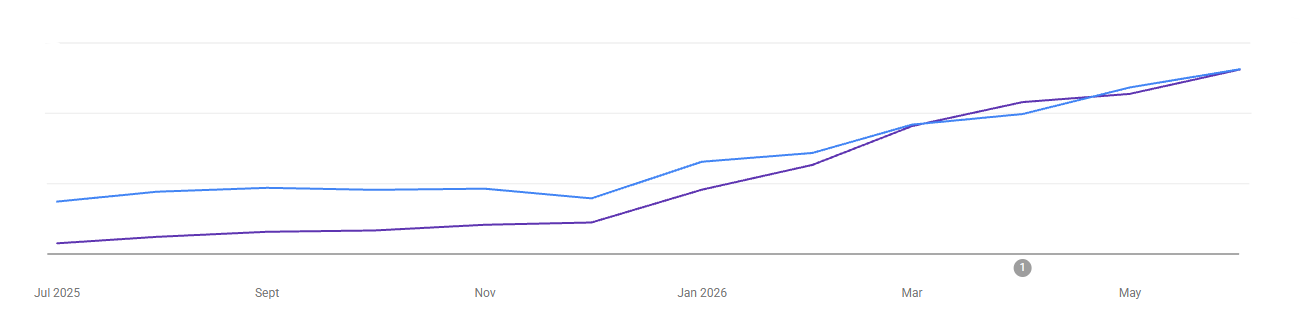
A respected clinic with room to reach more patients
In October 2025, the clinic’s website generated 1,600 organic booking-button clicks in a month. Its homepage and doctor profiles accounted for 1,210 of them: a strong foundation of patients searching for a familiar practice or named specialist.
The next opportunity was bigger. Patients across neighbouring towns were searching for knee pain, shoulder conditions, orthopaedic specialists, MRI examinations and radiology services without necessarily knowing the clinic’s name. The practice had invested in modern diagnostic equipment and specialist expertise, but its website had not yet fully translated those strengths into local search visibility and booking intent.
Commercially, the practice wanted more new patients, particularly privately insured patients, whose treatment pathways can generate substantially more revenue for the clinic than statutory-insurance appointments. That made relevant enquiries and booking-button clicks more important than undifferentiated traffic volume. We could measure the click to the external booking platform; insurance status, completed appointments and patient revenue required separate clinic-side data.
We built pages for the questions patients ask before choosing a specialist
Deliverables Roadmap
A staged search strategy, with performance milestones.
- Oct 2025Baseline1,600 monthly organic booking clicks; 1,210 from the homepage and doctor profiles.
- Nov 2025Symptom contentNative-language articles connect conditions to relevant specialists and booking CTAs.
- Feb 2026Paid supportGoogle Ads adds a complementary route to MRI and treatment enquiries.
- Mar 2026Local expansionTown-specific orthopaedics, MRI and radiology pages extend the catchment area.
- Jul 2026MomentumOrganic booking clicks reach 3,850 per month.
- Sep 2026Result4,250 organic booking clicks per month, including 2,100 from content pages.
Symptom articles. Starting in November 2025, we published medically focused German-language articles about conditions patients commonly investigate before contacting a doctor. Native-language writers developed clear, useful explanations, supported by clinical review where appropriate. Each article linked to relevant specialist services and a booking CTA. The purpose was to help a patient move from understanding a symptom to identifying the right next step.
Location pages. Beginning in March 2026, we created town-specific hubs and pages for orthopaedics, MRI and radiology. We tested the structure in one location before expanding it across the practice’s catchment area. The pages explained where patients could access particular services and linked them directly to the relevant booking journey.
Specialist pages and internal linking. Symptom content connected to treatment pages, doctor profiles and location information. Booking CTAs appeared at decision points throughout the journey. This helped both patients and search engines understand how conditions, services, doctors and locations related to one another.
MRI and radiology. We made the practice’s diagnostic capabilities easier to discover. Its investment in modern imaging technology became a clear part of the website’s service positioning, supported by dedicated MRI, radiology and location pages. For patients searching for a scan, the next step was explicit: find the appropriate service and click through to the appointment platform.
Technical SEO and conversion paths. We improved page structure, navigation, internal linking and the visibility of booking CTAs. The work was judged by whether more relevant landing pages generated clicks to the external booking platform, not by rankings alone.
Paid search. Google Ads launched in February 2026 as a supporting channel, with MRI among the priority landing-page journeys. Paid search contributed additional booking clicks, while organic remained the principal focus and largest source in this example.
Organic booking clicks grew across every page type
By September 2026, the clinic generated 4,250 monthly booking-button clicks attributed to organic search, compared with 1,600 in October 2025: an increase of 2,650 clicks, or 165.6% (rounded to 166%). Every measured page category contributed to that growth.
| Landing page type | Oct 2025 | Sep 2026 | Change |
|---|---|---|---|
| Symptom articles | 12 | 760 | +748 |
| Location pages | 0 | 520 | +520 |
| Specialist clinic pages | 180 | 550 | +370 |
| Services, contact and other pages | 108 | 270 | +162 |
| All content pages | 300 | 2,100 | +1,800 |
| MRI page | 90 | 480 | +390 |
| Homepage | 700 | 900 | +200 |
| Doctor profiles | 510 | 770 | +260 |
| Total organic | 1,600 | 4,250 | +2,650 |
Symptom articles became a substantial booking-click source. They rose from 12 to 760 monthly organic booking clicks. The number of symptom articles generating at least one booking click increased from seven to 48. The content was designed to meet patients early in their decision process and direct them towards the right clinical service.
Location expansion produced measurable demand. Pages that did not exist at the baseline generated 520 monthly organic booking clicks by September. 23 location pages recorded at least one booking click, showing how local service pages helped the clinic reach patients beyond its established immediate catchment.
Imaging and established pages grew too. The main MRI page rose from 90 to 480 organic booking clicks, while doctor profiles, the homepage and specialist clinic pages also increased. The strategy expanded discovery without depending on a single content format.
Across the site, pages producing at least one organic booking click per month increased from 50 to 115. That meant patients could reach the appointment journey from more than twice as many relevant entry points.
A 166% increase in organic booking clicks, with growth from every part of the site
Additional monthly organic booking clicks by page type
October 2025 to September 2026. All page types grew; combined gains total 2,650 booking clicks.
Content pages contributed 1,800 of the 2,650 additional monthly organic booking clicks — about 68% of the increase. The remaining 850 came from the MRI page, homepage and doctor profiles. The result was a broader, more productive organic search presence, with growth in both new patient-discovery journeys and established clinic pages.
Search everywhere: one strategy, more places for patients to find the clinic
Traditional Google SEO remained the foundation. But patients increasingly encounter information through different formats and platforms before choosing a healthcare provider. Our search-everywhere approach applied search principles to the clinic’s website, social profiles, directories and review listings so that the practice could be discovered and evaluated across more of that journey.
Each new article could inform Instagram carousels and LinkedIn posts that answered related patient questions. We aligned topics, terminology, profile information and links across channels. In this scenario, relevant Instagram and LinkedIn posts also appeared in Google results for selected searches, creating additional search-result visibility alongside the clinic’s own pages.
That is the practical advantage of optimising more than a homepage. A patient searching for a condition or service may encounter a clinic article, a doctor profile, a location page, an indexed social post or a relevant directory listing. Each provides another opportunity to recognise the practice and explore its services.
Social media wasn’t a separate content exercise. It worked alongside the SEO programme: the same clinical themes informed articles, short-form educational posts and platform profiles. We also improved the consistency of the clinic’s directory and review-site presence. This expanded the amount of accurate, clinic-owned or clinic-managed information available to search engines and prospective patients.
Search everywhere does not mean traditional SEO matters less. It means search strategy extends to the channels and assets patients actually use. Nor does every optimised asset automatically rank: visibility depends on the query, platform, competition and indexing. The objective was broader, useful search-result coverage, not a guarantee of occupying every result.
Organic led the increase; paid search added another 850 booking clicks
Paid search supported the programme, particularly around MRI and high-intent service searches. But organic search was the primary growth engine in the results: 4,250 of September’s 5,100 combined Google organic and paid booking clicks came from organic search.
Monthly booking-button clicks from Google search
Model: 1,600 in October 2025 to 5,100 in September 2026, a 219% increase.
Compared with October 2025, September 2026 produced 3,500 additional monthly booking clicks across Google organic and paid search. Organic contributed 2,650 of that increase, or about 76%; paid search contributed the remaining 850. The channels worked together, while the SEO strategy delivered most of the measured growth.
More booking intent for high-value services and new patient journeys
The clinic’s commercial priority was not simply to maximise appointment-button activity. It wanted to attract new patients, grow privately insured patient demand and make fuller use of its specialist and advanced imaging capacity. That shaped which services, symptoms and locations received attention.
The MRI page’s organic booking clicks rose from 90 to 480 per month, while new location pages contributed another 520. Specialist clinic pages grew from 180 to 550. These are signals of stronger interest in commercially important services, not proof of the insurance status or revenue of the people clicking.
The clinic’s external appointment platform was the final measurable step available to our marketing team. A booking click indicates that a visitor chose to proceed towards an appointment; it does not establish that a slot was available, an appointment was completed, or a private patient was acquired. To calculate private-patient acquisition and financial return, the clinic would need to connect booking-platform and practice-management records to the website journey.
The practice director saw the impact beyond the website
“We wanted more people across the region to discover our specialists and diagnostic services, not just patients who already knew our name. The website now creates far more opportunities for patients to find the right service and move towards an appointment. It has also given us a stronger platform for communicating our expertise, supporting our locations and reaching people across search and social media.”
Dr Lutz, Practice Director
What the results show
Over the 12-month period, the clinic increased organic booking clicks by 166%, expanded the number of pages producing booking intent from 50 to 115, and created new discovery paths for symptoms, specialist services, MRI and radiology across a wider local catchment area.
Paid search contributed additional high-intent traffic, while coordinated social and directory optimisation helped the clinic show up through more of the assets it owned or managed. The common thread was a strategy focused on patients taking a meaningful next step — clicking from the clinic’s website to its appointment platform.
Could this work for your practice?
Your patients may discover you through a symptom search, an MRI service page, a specialist profile, a social post or a local directory. The opportunity is to connect those touchpoints to a clear path towards an appointment.
On a 30-minute call, we’ll look at where your booking clicks come from, which services and locations have the greatest commercial potential, and how a search-everywhere strategy could support your growth.