How a new Warsaw restaurant got 235 website reservations a month with no ad budget
- 235attended reservations through the website in October, up from 215 in September
- 85 to 2,294monthly Google search clicks, February to September (27 times higher, after a July peak of 3,047)
- 7 to 213monthly clicks to the business lunch menu page, July to September
- 400Google reviews at a 4.8 average, collected in the first six months of trading
- Client
- The Exchange, Warsaw, Poland
- Industry
- Hospitality: restaurant, sports bar and corporate events venue with more than 260 seats
- Timeframe
- January to October 2026. The restaurant opened in late April
- Our role
- Website strategy, development and management, technical SEO, bilingual content, Google Business Profile, local listings, PR coordination and collaboration with the restaurant’s external social media team
- Investment
- Approximately €850 per month. No paid advertising
The Exchange opened in central Warsaw with a brand-new domain, no reviews and no paid advertising. We built its website and local search presence from scratch, and by October the website was producing 235 attended reservations a month.
Opening a 260-seat restaurant with no established demand
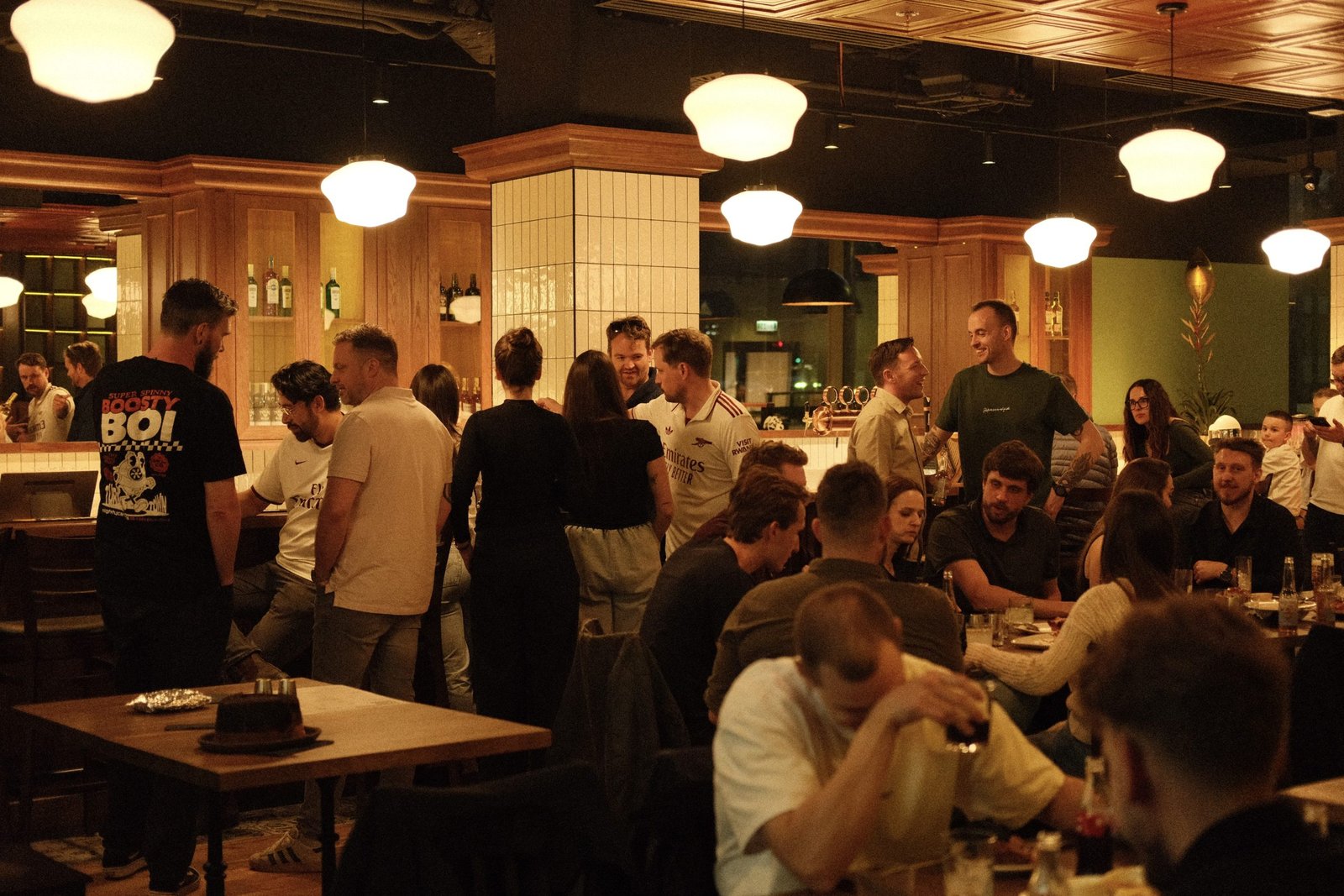
Warsaw has plenty of restaurants, bars and places to watch sport. For a new venue, good food and a good location don’t fill the tables by themselves. People have to find the place, see what makes it different, trust it and have a reason to visit.
The Exchange opened in late April 2026 at Rondo ONZ, in Warsaw’s business district. It had a lot going for it: room for more than 260 guests, food from a Josper charcoal grill, cocktails, live international sport, augmented-reality darts and space for events.
The location also gave it two quite different audiences. During the working week, thousands of office workers nearby need somewhere to eat lunch or meet colleagues. In the evenings and at weekends, the restaurant can attract groups who want to watch sport, celebrate an occasion or spend several hours somewhere.
In January 2026, when we started building the digital presence, there was no established website, no search history, no reviews and nobody searching for the restaurant by name. There was no paid advertising budget either.
That gave us two jobs:
- Make the restaurant easy to find and easy to book as soon as possible.
- Turn that visibility into a dependable source of guests once the opening excitement faded.
We treated it as a commercial search strategy from the first week.
We built the website around the reasons people choose a restaurant
Restaurant guests don’t all search the same way. Someone working near Rondo ONZ may look for a business lunch, a British expat may want somewhere to watch Premier League football and a company administrator may need a venue for a team event. Each of them needs a quick route from research to a decision.
We built the site in English and Polish, with a clear language structure and structured data for the restaurant, menus, opening hours, organisation and events. By the end it had about 45 English pages and 30 Polish pages, covering menus, event pages, local guides and articles.
We owned the website strategy, development, content and ongoing management. We also ran the Google Business Profile, built local listings and coordinated PR while working with an external social media team.
Every page had a route to a reservation
A persistent booking button appeared across the site, backed by calls to action inside relevant content. They all led to the restaurant’s booking platform, 7tables. Someone reading about where to watch football could reserve a table straight away, and someone browsing the menu could book without going back to the homepage.
Groups of more than ten guests followed a different route. They were sent to the restaurant’s events team through an enquiry form, email or phone call, which let the restaurant handle ordinary table bookings separately from corporate events and large gatherings.
The World Cup gave us a launch spike, and we planned for what came after
The Exchange opened shortly before the 2026 FIFA World Cup, which was a major chance for a new sports bar. Thousands of fans would be looking for places to watch matches, including visitors, expats and residents who didn’t know the restaurant existed yet.
Once the core pages and technical foundations were in place, World Cup content was one of the first things we published. It covered guides to watching football in Warsaw, sports bar recommendations and content around relevant matches and events. We wanted to reach people before they had chosen a venue.
Clicks and impressions in Google Search Console
The same data as the chart above, as it appears in the reporting tool.
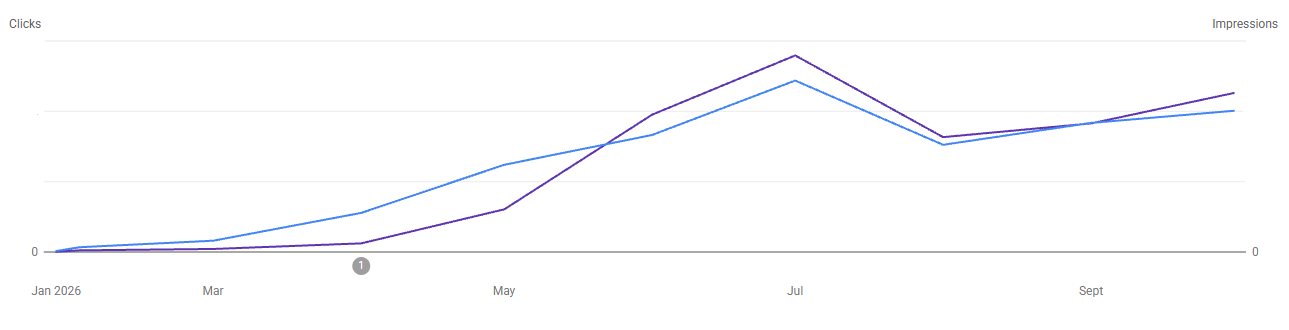
During the tournament the website carried a persistent booking banner that pointed out limited availability and made booking possible from any page. Management invested in PR, influencer exposure and social media, and we coordinated PR and worked with the external social media team so the website covered the same topics being promoted elsewhere. No paid search or paid social advertising was used.
Guests often found the restaurant through one channel and finished their research in another. Someone might see an Instagram post, hear about the place from a friend and then search Google for The Exchange before booking. The website and Business Profile had to catch that interest wherever it started.
Monthly Google search clicks, 2026
July was the World Cup peak. September recovered to 75% of it.
- Content publishing starts (week of 22 March)
- Restaurant opens (late April)
- PR, influencer and social campaigns start (early May)
- World Cup final on 19 July
July was the strongest month, with 3,047 clicks, and the Business Profile also had its busiest period around the World Cup, from mid-June into early July. Clicks fell to 1,905 in August once the tournament ended, then recovered to 2,294 in September, about 75% of the July peak. The drop is part of the story, so we left it in.
The timing suggests the tournament was an important source of demand, though the data can’t separate its effect from the opening, PR, social media and the rest of the activity. The question that mattered more was whether the restaurant could keep attracting guests without a major football competition creating demand. Lunch was our first answer.
The business lunch page went from 7 to 213 clicks in three months
The lunch page overtook the old PDF menus
Organic clicks in July and September 2026. The lunch page also had 57 clicks in August.
PDF menus July
Lunch page Sept
PDF menus Sept
Lunch page
The World Cup was temporary. Business lunch offered a chance to reach nearby guests every working day. The Exchange sits in one of Warsaw’s busiest office districts, and many people who work there choose where to eat based on price, convenience and what is on offer that day.
The restaurant introduced an affordable business lunch at about €8.14, with soup, a main course and a drink. The menu changes daily, with themes such as Mexican Monday, Polish Wednesday and Italian Thursday, which gives people nearby a recurring reason to check the website.
From PDF menus to HTML pages
Much of the menu information started out as PDF files. We moved the important menus into HTML pages that guests can browse on their phones, with booking buttons next to the menu.
| Month (2026) | Organic clicks to the lunch menu page |
|---|---|
| July | 7 |
| August | 57 |
| September | 213 |
Over the same months the old PDF menus fell from 106 organic clicks in July to 8 in September. The new format made the menu easier to read and update, and the search data shows growing interest in the lunch menu itself.
We changed the publishing process to match how people plan lunch
At first the aim was to publish each day’s lunch menu before 9 a.m. The team then noticed that some office workers make their plans before the working day starts. So we began refining the process to publish the next day’s menu before 8 p.m. the previous evening. That took coordination between the restaurant’s operations team and us. We also expanded into commercial searches such as “business lunch Warsaw”.
In other words, the lunch work started with how office workers decide where to eat and ended with a change to the restaurant’s evening routine. The website became part of how the restaurant tells nearby guests what is on offer each day.
Lunch is mostly walk-in trade, with about 85% of lunchtime guests arriving without a reservation. Online booking numbers therefore undersell what the lunch content does, because part of its job is to influence where nearby workers choose to eat.
Google Business Profile views reached 15,000 a month, with 375 reviews at 4.8 stars
The Exchange on Google Maps
The Business Profile shows the rating, review count, photos and booking route a guest sees before deciding.
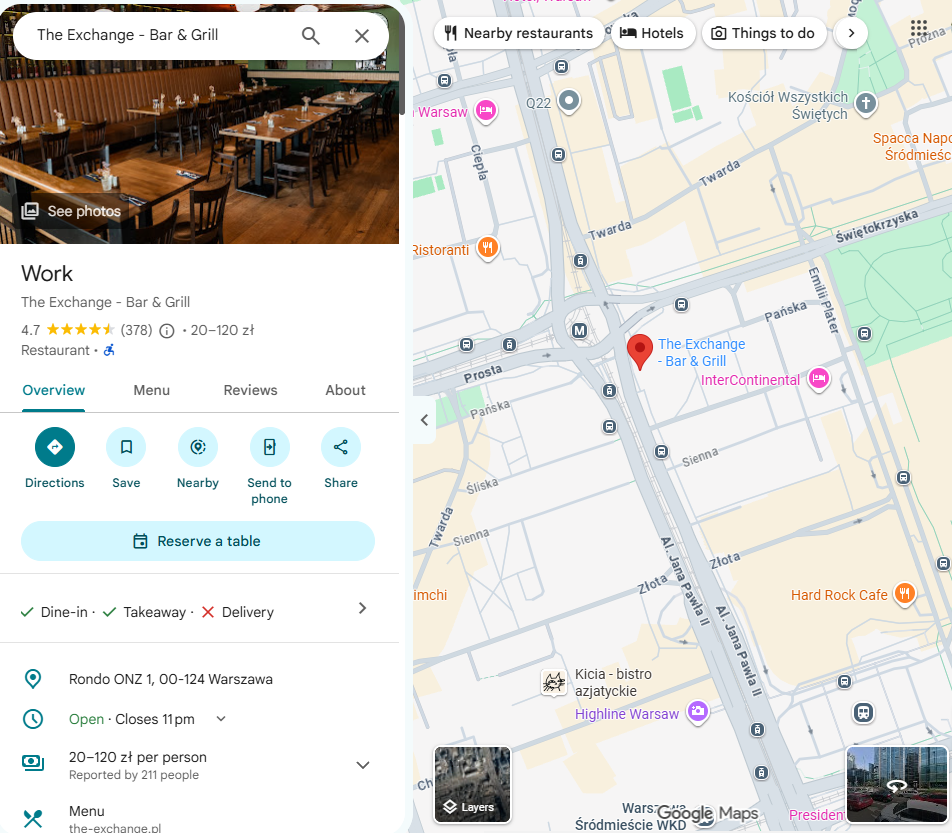
A large part of a restaurant’s customer journey happens outside the website. People compare venues on Google Maps, look at photos, read reviews, check menus and ask for directions. A new restaurant with no review history starts behind its established competitors, so we treated the Business Profile as a core marketing channel.
Menu, highlights, photos and videos on the Business Profile
Guests browse these before they reach the website, so the menu needs to stay current and outside publishers add to what they see.
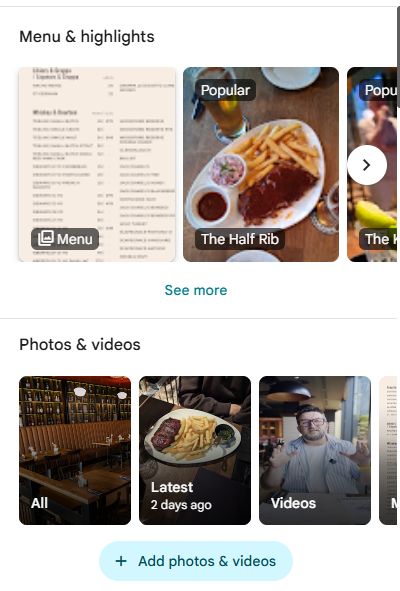
We built the profile alongside the website, with accurate opening hours, business information, menus, photos and relevant categories. We also set up the restaurant on Tripadvisor, TheFork and Apple Maps as those third-party publications are often used by LLMs to establish what an entity is about.
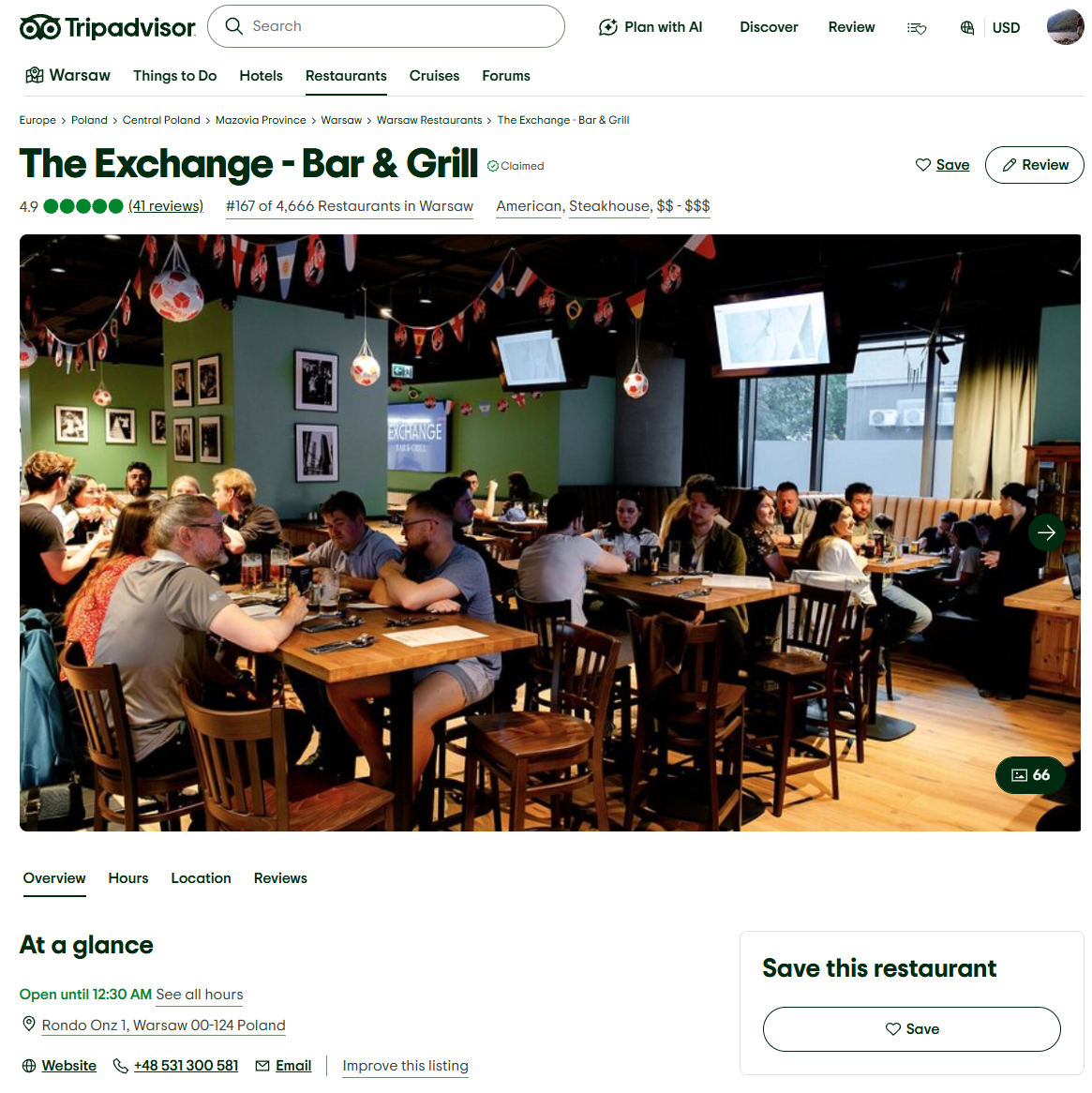
The Exchange on Tripadvisor
Guests compare venues across several platforms, so the listing details and reviews need to match everywhere.
From zero reviews to 400
By October 2026 the restaurant had about 400 Google reviews at an average of 4.8 stars. Working with management, we set up a simple collection process: QR codes on bills and table cards give guests an easy way to leave feedback. The invitation goes to every guest, and we don’t limit it to people who have said they were happy. For someone comparing The Exchange with an established venue, hundreds of recent reviews say things the restaurant’s own marketing can’t.
What guests did on the profile
Monthly profile views grew from 2,530 in the first month to an average of about 15,000 between August and October. Over the latest three-month period the restaurant also recorded:
- About 35,000 reported engagements with profile content, including photos, reviews and menus
- About 400 direction requests
- 30 to 40 call-button interactions a week
These measure different behaviours and can’t be added together as unique visitors or completed reservations. The 35,000 figure is a broader reported total and not a standard Google Business Profile interaction count. Even so, the activity shows why complete local listings matter: guests were looking at the evidence they needed to decide whether to visit.
Relevant traffic turned out to matter more than total traffic
The Exchange has several features that could support content, including the Josper grill, which cooks meat, fish and vegetables over charcoal. We first invested in informational content about Polish beef, pork and other meats. Some of those articles ranked well in Google and were cited by AI tools, but they brought in no meaningful booking activity.
The content was fine. The audience was wrong. Someone researching Polish beef in another city or country may be interested in the subject and still have no chance of becoming a customer in Warsaw. We moved our effort to topics closer to the restaurant’s commercial opportunities.
Sports content attracted more relevant enquiries
- Guides to sports bars in Warsaw
- Where to watch Premier League football
- Where to watch less commonly televised sports such as rugby, American football, Formula 1, tennis and Australian football
The niche sports articles didn’t always bring much traffic. After we published them, though, the restaurant noticed more enquiries about showing those sports. That doesn’t prove the articles caused the enquiries, and it does suggest they reached people looking for something The Exchange could offer.
A high-ranking article about Polish beef can attract readers from around the world. A lower-traffic article about where to watch rugby in Warsaw can reach a small group of people who are choosing a venue right now. For a local restaurant the second audience is worth more, and that changed which rankings we counted as wins.
Corporate events and group bookings are the next opportunity
With room for more than 260 guests and a business-district location, The Exchange suits companies that need a venue for team celebrations, integration events, work parties and client gatherings. It already had food, drinks, live sport, interactive darts and organised entertainment to offer them. As the launch activity settled, we built content around company parties, team integration events and other group occasions.
The website sends groups of more than ten guests to a dedicated events manager, and the restaurant hosts about 12 corporate or private events a month. A single group enquiry can represent far more guests than an ordinary dinner booking. We don’t have event revenue or a count of how many events came from organic search, so we treat corporate events as a growing opportunity and not as a proven SEO revenue result.
AI assistants mention the restaurant in 76% of tracked answers
How often the restaurant appears in AI answers
Across 40 tracked restaurant-discovery prompts, 76% of answers mentioned or cited The Exchange.
Guests increasingly ask ChatGPT, Claude and other AI assistants where to eat. We use mentions.so to track 40 prompts relevant to The Exchange, including sports bars, steak restaurants and places to watch Premier League football in Warsaw. Across the tracked answers, the restaurant was mentioned or cited 76% of the time and both mentioned and cited in 50%.
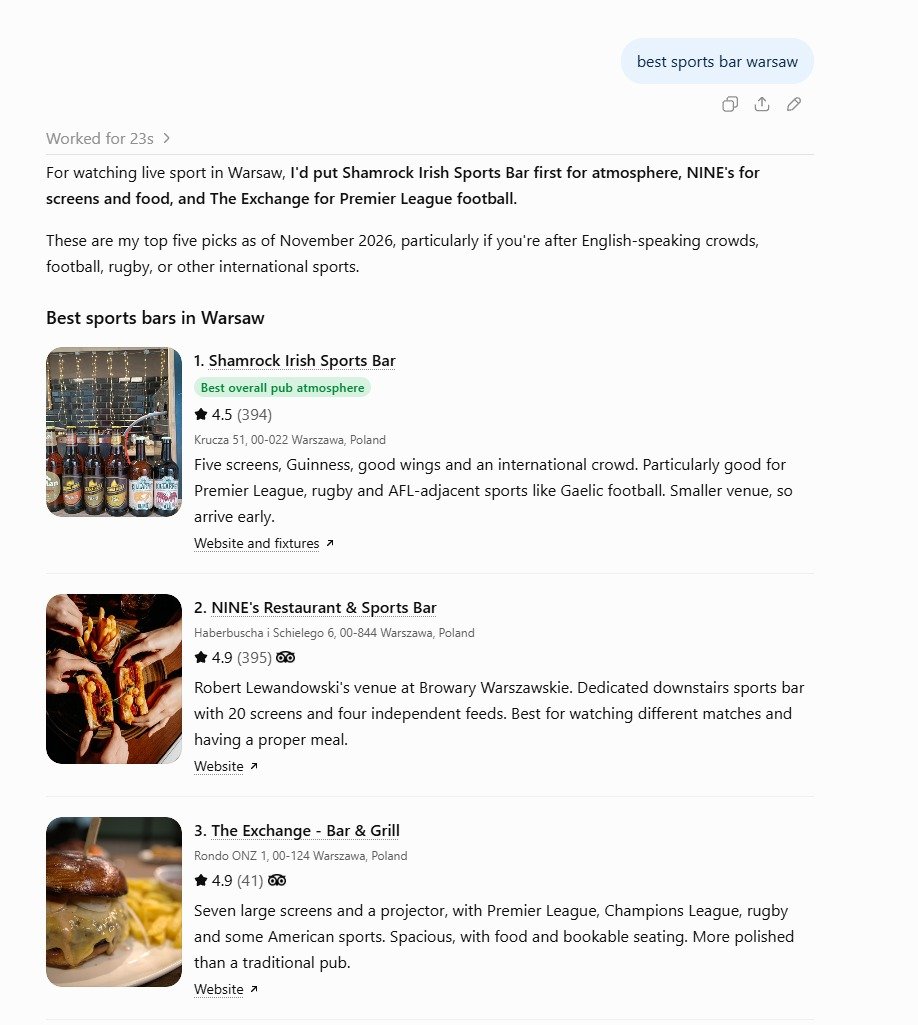
For the prompt “best sports bar in Warsaw”, the restaurant is often listed second or third, and regularly in front competitors that have operated for decades. Results vary between runs, so read that as a typical position and not a permanent ranking.
ChatGPT’s answer to “best sports bar in Warsaw”
The Exchange appears in the top three, ahead of venues that have traded for much longer.
Where the citations come from
AI assistants sometimes cited The Exchange’s own list articles when they discussed the competitors in them. When they recommended The Exchange itself, the supporting citations were concentrated on the restaurant’s own website. That points to a gap in independent coverage.
The next phase is earning more mentions from local publications, hospitality guides, event websites and other credible third-party sources. That documents the food, facilities, events and guest experience in more places on the web, which gives AI tools more outside evidence to draw on. We treat AI visibility as a supporting measure and count reservations as the main one.
Website reservations reached 235 a month, close to half of all bookings
Website share of September reservations
Close to half of all reservations came through the website.
By September the website was producing 215 attended reservations a month, and in October the number rose to 235. These came through the website’s booking journey, and they exclude walk-ins, direct reservations and corporate event enquiries. That matters because The Exchange isn’t a reservation-only restaurant.
How website bookings fit a mostly walk-in restaurant
- The restaurant is open seven days a week, with roughly 120 guests at weekday lunch, 110 on weekday evenings and 180 on each weekend day.
- Lunch is mostly walk-in trade. Reservations matter most in the evenings, at weekends and during sporting events.
- Thursday and Friday evenings bring about 85 to 100 guests between 5 p.m. and closing, and during Premier League fixtures about half the tables may be reserved.
- Guests can book ordinary tables for two to ten people. For major matches, bookings are managed around kickoff: guests are asked to arrive before the match begins, and unclaimed tables go to walk-ins.
With about 450 reservations a month across all channels, the 215 website bookings in September were roughly 48% of the total. That says more about the website’s commercial role than comparing bookings with the 260-seat capacity does, because tables turn over several times a day and most lunch guests never book. The 260 figure is how many people can sit at one moment.
The conversion rate became measurable
In September the website recorded 14,442 sessions across organic, direct, referral, social and other sources. The 215 attended reservations give a session-to-attended-booking rate of about 1.49%, and across August to October the aggregate rate was 1.8%.
The booking platform is external, so counting booking-button clicks alone would overstate conversions. We count whether a website visitor goes on to complete and attend a reservation.
Supporting estimate: the dining value of those reservations
Restaurant owners think in occupied tables, so we also modelled what the reservations are worth in spend. The average reservation covers four guests. Before the menu changes, average spend was about €25.81 per guest. A revised menu raised it by 20% in September and October, to about €30.98 per guest, so an average four-person booking is worth roughly €124.
| Booking model | September | October |
|---|---|---|
| Website attended reservations | 215 | 235 |
| Average guests per reservation | 4 | 4 |
| Estimated guests represented | 860 | 940 |
| Average spend per guest | €30.98 | €30.98 |
| Modelled gross dining value | approx. €26,600 | approx. €29,100 |
These values are modelled from average party size and spend. They are not audited restaurant revenue. The website bookings also aren’t necessarily extra guests caused by SEO, since someone may have heard about the restaurant through PR, social media or word of mouth before visiting the website to book.
Why we don’t claim a marketing ROI
Our monthly engagement cost about €850. Gross dining spend is not profit, and the model leaves out ingredient costs, staffing, taxes, discounts, operating expenses and how many guests would have booked without the marketing. The menu changes also lifted average spend independently of the SEO work. So we report the outcomes we can measure and explain what each one represents.
What changed for The Exchange
By October 2026 the restaurant had a bilingual website, strong visibility in Google Search and Maps, about 400 reviews and a measurable online booking channel.
- Opening awareness turned into ongoing demand. World Cup content caught the launch opportunity, and lunch, sports and event content support more regular discovery.
- Content priorities moved from broad traffic to commercial relevance. We dropped broad informational content that attracted readers unlikely to visit and prioritised searches linked to dining, sports viewing and group bookings.
- The lunch menu became an operational routine, with updates timed around when nearby guests make their decisions.
- A new listing became an established local reputation. Reviews, photos, menus and complete business information gave prospective guests more reasons to choose the restaurant.
- Isolated marketing activity became a measurable customer journey. Search Console, Business Profile, booking data and AI monitoring give a clearer picture of discovery, engagement and reservations.
The restaurant now has a marketing operation it can measure, improve and adapt to its commercial priorities. That matters more to us than any single ranking or traffic number.
“We knew that launching a new restaurant with a new website would make local search and customer acquisition challenging. MOOT SEO helped us establish the foundations quickly and made a complicated part of the launch much easier to manage.
As the initial excitement of opening has settled, our focus has shifted towards consistent demand and stronger business performance. Having a reliable website marketing team that understands the realities of running a restaurant gives us a measurable, effective and scalable way to keep improving.”
Justin, Managing Director, The Exchange
What we’re building next
- Business lunch: keep improving the menu publishing process, expand lunch content that nearby office workers search for and make it easier for them to decide where to eat.
- Corporate events: build dedicated pages and enquiry journeys for company parties, team integration events and larger groups, supported by the restaurant’s events manager.
- Independent visibility: earn more relevant coverage on third-party websites to strengthen the restaurant’s reputation and improve discovery in search and in AI assistants.
The goal is a restaurant that is easier to discover, easier to choose and easier to book.
Could your restaurant generate more bookings from local search?
Your guests might find you through Google Maps, a review, a menu, a social post, an event guide or an AI recommendation. Finding you is only the start. They still need accurate information, confidence in the venue and a simple way to reserve a table. We connect those steps through website development, technical SEO, local search, content and commercial marketing strategy.
On a 30-minute call we’ll review how guests find your restaurant today, where your digital presence may be losing bookings and which improvements offer the biggest commercial opportunity.